Atelier Bonryu(E)
zone plate photography


Atelier Bonryu(E)
zone plate photography

Laboratory: Zone Plate Photography
Principle of Zone Plate Photography
- Remark -
Remark#4: Depth of Focus, Depth of Field
In this page we describe depth of focus and depth of field. It should be noted that the definitions of these terms are different for a camera with a glass lens as described in Theory of Zone Plate Photography - Focusing and Depth of Field. The reason is because the magnitude of a blur due to zone plate imaging is usually larger than a circle of confusion even when best focusing is attained, and the principle of image formation is different from the case of a glass lens.



From this equation,

Therefore, the following equation is derived.

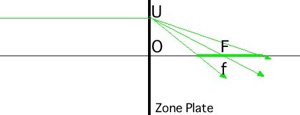
Depth of focus for a point source at infinity
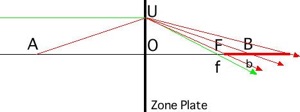
Depth of focus for a point source (A) at finite distance
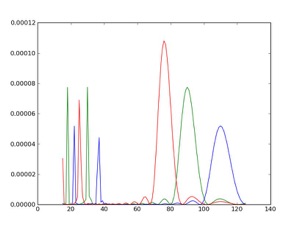
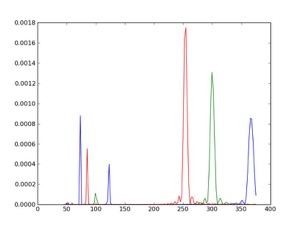
Numerical simulation of depth of focus: A distribution of light intensity on the optical axis is simulated on the computer program used for the explanation of the zone plate. The simulation is carried out for two zone plates, i.e., a zone plate with a focal length of 90 mm and a number of zones of 15, and a zone plate with a focal length of 300 mm and a number of zones of 65. The design value of the wavelength is 550 nm for both the zone plates. The intensity distribution of lights on the optical axis are calculated for 3 different wavelengths (lamA) of 450, 550, 650 nm. As for depth of focus the result of the simulation is consistent with the estimation by the above equation.
In the figures there are several sub-focal-points at f/(odd number). This is one of the features of a Fresnel-type zone plate, and for this reason Fresnel-type zone plate is called a multi-focus optical system. On the other hand, a Gabor-type zone plate has only two foci at f and -f.
Simulation of depth of focus (1)
Light intensity distribution for wavelengths of 450 (blue), 550 (green), 650 (red) nm by a zone plate with wavelength of 550 nm, number of zones of 15, and focal length of 90 mm. Thin peaks in the left side are sub-focal points with the focal length of f/3 and f/5.
Simulation of depth of focus (2)
Light intensity distribution for wavelengths of 450 (blue), 550 (green), 580 (red) nm by a zone plate with wavelength of 550 nm, number of zones of 65, and focal length of 300 mm. Thin peaks in the left side are sub-focal points with the focal length of f/3 and f/5.
From the above figures the following conclusion is obtained. If the design value of the wavelength is 550 nm the zone plate with a focal length of 90 mm and a number of zones of 15 can focus a light of wavelengths of 450 nm and 650 nm at the focal point, but the zone plate with a focal length of 300 mm and a number of zones of 65 can no longer focus a light of wavelengths of 650 nm and 450 nm. However, it does not mean that a photograph cannot be taken by incident lights including these wavelengths. Depending on a feature of the sensor and distribution of wavelength of the incident light a photograph with unexpected effects may be taken, which is a best part of zone plate photography.
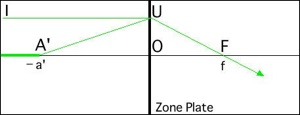
Depth of field: As described above depth of focus means the permissible range of an image location, whereas the depth of field means the permissible range of the location of an object for a fixed position of the image plane. Depth of field of a zone plate can be calculated similarly as depth of focus, where the limits of the permissible range of the location of the object is determined so that the phase shift of the light rays passing through the transparent zones should be less than half a wavelength.
First, we assume that a light from a point source (A) at a finite distance proceeds through a point (U) on the n-th zone to a position (B) on an image plane. Then the following equation holds.














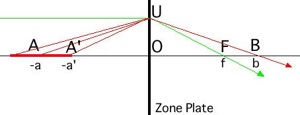
The depth of field for an image screen adjusted to an object at finite distance.
The depth of field for an image plane adjusted to an object at infinity.